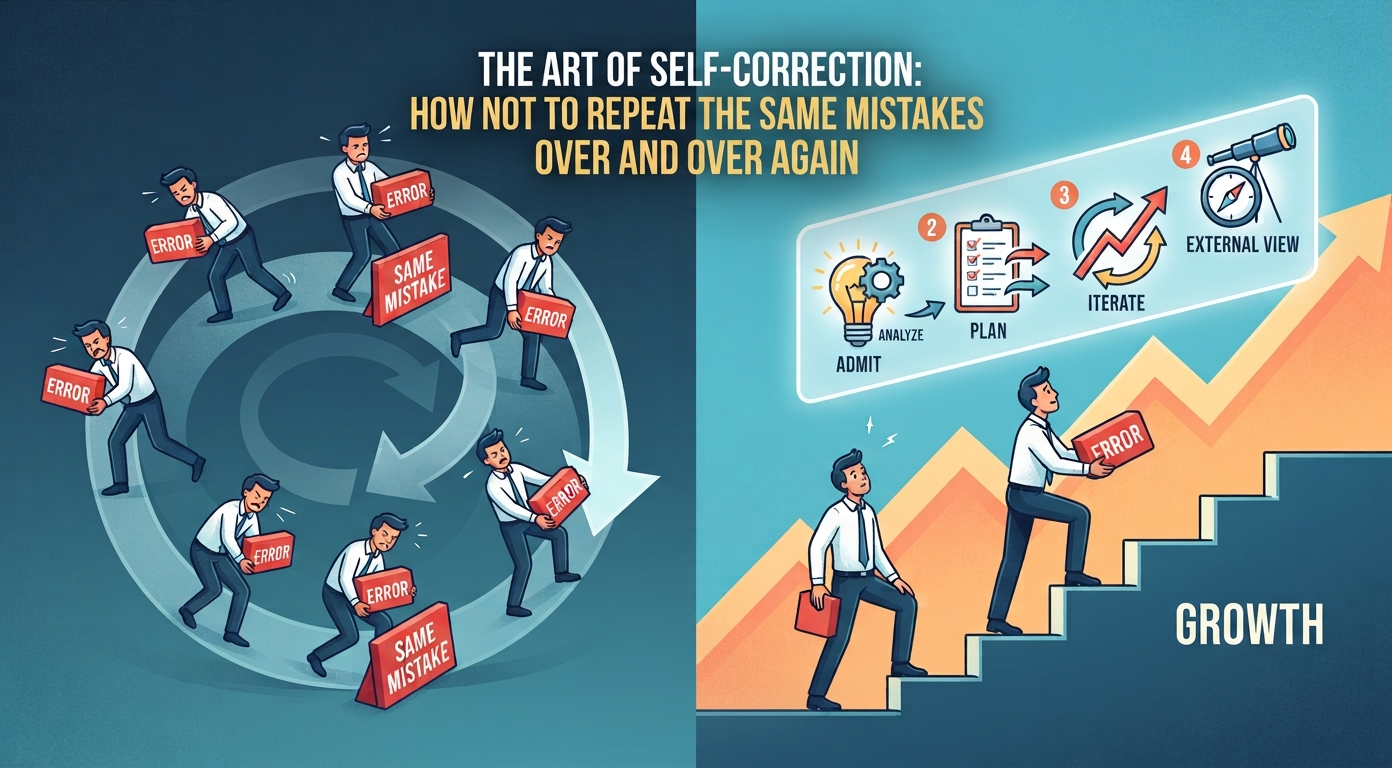
The Art of Self-Correction : How Not to Repeat the Same Mistakes Over and Over Again
We have all been there: promising ourselves we will never repeat a specific blunder, only to find ourselves trapped in the exact same pattern a few months later. Breaking free from this loop requires more than just good intentions—it requires a systematic approach to behavior change.
The Basic Principle
There is a famous adage often used to describe this trap: "Insanity is doing the same thing over and over again and expecting different results." While frequently misattributed to Albert Einstein, this quote actually originated in modern literature—but its psychological truth remains absolute. If you do not alter your inputs, you cannot expect your outputs to change.
To see how we can break this cycle, let’s follow Sarah, a marketing manager who found herself trapped in a frustrating loop: every time her team launched a quarterly campaign, the final week devolved into a chaotic mess of missed deadlines, overnight shifts, and stressed clients.
To stop the cycle, Sarah had to move through a four-step cycle of self-correction.
1. Admit Your Mistakes
You are not perfect, you are nothing but merely human being and human make mistakes. Accept and live with it.
The first and most difficult hurdle is radical honesty. You cannot fix a problem you refuse to acknowledge. Human psychology naturally pushes us to rationalize our failures, blame bad luck, or point fingers at external circumstances.
To stop the loop, you must actively drop your defenses. Acknowledge the reality of the situation and explicitly admit your role in it. Saying "I made a mistake here" instantly shifts your mindset from defensive denial to active problem-solving.
Sarah's Step 1: For the past two quarters, Sarah blamed her team's panic on external factors: a difficult client, a slow vendor, or sudden sick leaves. But after a third disastrous launch, she stopped making excuses. She sat down and admitted the hard truth to herself: "The vendors and clients aren't the problem. My project timelines are poorly planned, and I am not managing our buffers correctly."
2. Analyze the Situation
Once you have accepted ownership, you need to understand the root cause of what went wrong. A proper analysis requires two distinct vantage points:
• Seek an External Perspective: We are naturally biased when judging our own actions. To gain a cleaner, objective perspective, present the facts to a trusted mentor, colleague, or friend. Ask for their assessment. They can easily spot the blind spots that your ego might be trying to hide, but when you ask for someone advice, make sure it is from someone you respect and cherish, in other words, someone that your ego would value, otherwise you will only put an eye on their inputs.
• Take a Helicopter View: Step back and zoom out. Contemplate the situation as if you were an outside observer watching a movie of your life. What patterns do you see? What triggers led to the mistake? Taking a macro-level view helps separate your emotions from the data, allowing you to see the chain of events clearly.
Sarah's Step 2: Sarah took a senior project manager from another department out for coffee and laid out her timeline. Her colleague immediately spotted a blind spot: "You are scheduling creative reviews too late in the process, leaving no room for revisions." Sarah then took a "helicopter view" of her past three projects. She noticed a clear pattern: she always said "yes" to last-minute client requests without adjusting the final launch date.
3. Design an Actionable Change Plan
An analysis is useless without a strategy. Armed with data about why you failed, you must now construct a concrete, actionable plan for how you will handle a similar situation in the future.
Do not rely on vague promises like "I will try harder next time." Instead, build practical guardrails. Design specific "if-then" scenarios so your brain knows exactly how to pivot when a trigger reappears.
Sarah's Step 3: Sarah built a new action plan with rigid guardrails for the next quarter. First, she moved the internal creative review deadline up by a full week to allow for revisions. Second, she created a strict "if-then" rule for herself: "If a client requests a change within 10 days of launch, then I will explicitly inform them that the launch date must push back by 48 hours."
4. Iterate and Adapt
Growth is not a straight line. Implementing a new action plan does not mean you will execute it perfectly on your first attempt.
Treat your life like a software deployment: launch your plan, observe how it performs in the real world, and iterate. If a piece of your new strategy fails, do not view it as a total defeat. Treat it as a brand-new data point. Refine the plan, adjust your guardrails, and try again.
Sarah's Step 4: During the next launch, Sarah's new timeline worked beautifully—until a vendor went completely radio silent. The launch was still a bit rushed, but because she had built in that extra week for creative reviews, they didn't miss the deadline. Sarah didn't despair over the slight panic; instead, she iterated. For the following quarter, she kept her review timeline but added a backup vendor to her action plan.
Breaking the Loop
Making a mistake once is a natural part of learning. Repeating it is simply a sign that your process is broken. By systematically admitting fault, analyzing the root causes from all angles, planning your changes, and continuously iterating, you transform your stumbles into stepping stones for genuine growth.
Good luck to become a better you!!